


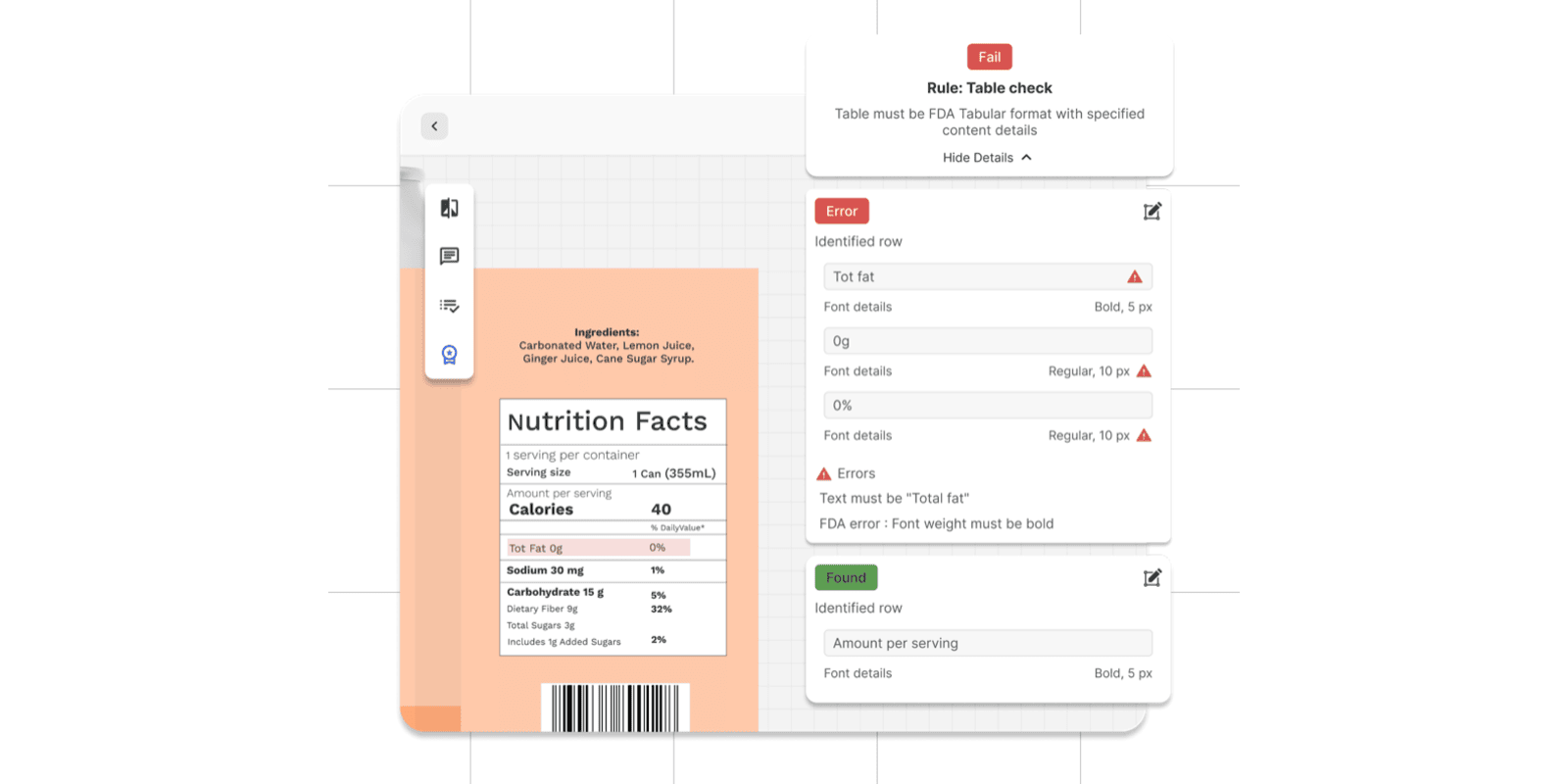

There's a version of this story that ends badly.
A product launches. Weeks later, someone in regulatory affairs notices it. An allergen statement buried in the fine print is formatted incorrectly — not wrong in substance, but wrong in font size, a fraction of a point below the FDA threshold. The product is already on shelves in four states. Legal gets involved. The recall doesn't make headlines, but the internal damage does: reprints, retailer relationship strain, a three-month compliance review, and a post-mortem that leads exactly nowhere because nobody can reconstruct which version of the artwork was approved, or when, or by whom.
The real sting? The error was in the file from the start. It went through four rounds of revision, two stakeholder approvals, and a final sign-off, and nobody caught it, because nobody was specifically looking for it.
There's another version. Same product. Same team. Same tight launch timeline. But this time, the error is caught before the file ever leaves the building — flagged automatically during proofing, routed to the right person, resolved in minutes. The launch happens on schedule. The regulatory team never finds out there was ever an issue, because there wasn't one — not by the time anything moved.
The difference between these two versions isn't talent or diligence. It's where compliance lives in the artwork process.
Compliance as an afterthought is a design flaw
Most packaging teams didn't build their compliance process intentionally. It evolved — a checklist added after a close call, a manual review step bolted on at the end, a senior manager who's become the unofficial last line of defense before sign-off.
This approach has a structural problem: by the time a compliance issue surfaces, the artwork has already traveled through brief, design, revision, and stakeholder approval. Fixing it at that stage doesn't just mean correcting a label. It means reopening files, restarting approvals, and sometimes renegotiating timelines with contract manufacturers.
The cost of a compliance error compounds with every step it travels before it's caught.
The brands that sidestep this trap share a common philosophy: they treat compliance not as a gate at the end of the process, but as a thread woven through it from the beginning.
What "compliance by design" actually looks like
When compliance is designed into the artwork workflow — not appended to it — a few things shift:
Rules become shared, not siloed. Instead of a compliance officer carrying regulatory knowledge in their head (or in a spreadsheet nobody else uses), standards get codified into the workflow itself. Allergen formatting requirements, barcode specifications, logo placement rules, mandatory claims — these become part of the brief, not a surprise at the end of review.
Errors surface early, when they're cheap. A flag at the briefing stage costs a conversation. The same flag at press-ready stage costs a reprint. Automated compliance checks that run during proofing — not after — change the economics of quality dramatically.
Reviewers stop doing the wrong work. When AI handles the repeatable, rule-based checks (is the font the right size? is the barcode scannable? does the allergen table match the brief?), human reviewers can do what they're actually good at: judgment calls, cross-functional alignment, creative decisions. The cognitive load shifts from checking to deciding.
The audit trail tells a story. When regulators or retailers ask for proof that a label was reviewed and approved by the right people in the right sequence, a structured artwork process generates that record automatically. Scrambling for email chains and PDF version histories is a symptom of a process that was never designed to be accountable.
The pressure teams are actually facing
It would be easy to frame this as a purely regulatory problem — something that only matters when an FDA inspector comes knocking. But the teams running into the most compliance pain aren't the ones cutting corners. They're often the most ambitious: fast-growing brands scaling from 20 SKUs to 200, launching into new markets with different regulatory requirements, managing regional variants across multiple languages and labeling standards.
Speed creates compliance risk not because teams stop caring, but because the processes that worked at smaller scale start to crack. What was manageable in a shared folder and a few email threads becomes a liability when you're running 30 active artwork projects simultaneously.
At this inflection point — the scaling point — the cost of not fixing the process becomes visible. Missed claims. Inconsistent branding. A version of the file that shouldn't have gone to the printer. A market launch delayed by two weeks because a regulatory review found something that should have been caught in week one.
The brands that scale successfully are the ones who rebuild their artwork process before it breaks under pressure — not after.
One question worth asking your team
Here's a practical test: in your current artwork process, at what point does a compliance error become visible?
If the answer is "when the compliance team reviews it" or "when the artwork goes to the printer" or — worse — "when a customer or retailer flags it," you're operating with compliance as a checkpoint, not a capability.
If the answer is "as soon as a designer saves a file" or "when a rule is violated during proofing," you've built compliance into the process itself.
The gap between those two answers is where most packaging recalls, reprints, and regulatory headaches live.
The person who always catches it last
In most packaging teams, there is one person — usually a compliance officer, a senior brand manager, or someone in regulatory affairs — who has become the unofficial safety net. They review everything before it goes to print. They've caught enough errors over the years that nobody questions the step anymore. It just exists.
This person is both the most valuable person in the room and a serious process risk.
They're valuable because their expertise is real. They're a risk because the entire downstream cost of a late-stage catch falls on their shoulders — and on the project timeline. Every error they find at press-ready stage is an error that could have been found in week one. And every hour they spend verifying font sizes, barcode symbology, and allergen formatting is an hour they're not spending on the regulatory judgment calls that actually require a human.
The solution isn't to remove that expert from the process. It's to give them better inputs. When the repeatable, rule-based checks are handled automatically — and handled early — the expert's review becomes genuinely strategic. They're making calls, not re-doing work that a system could have done for them.
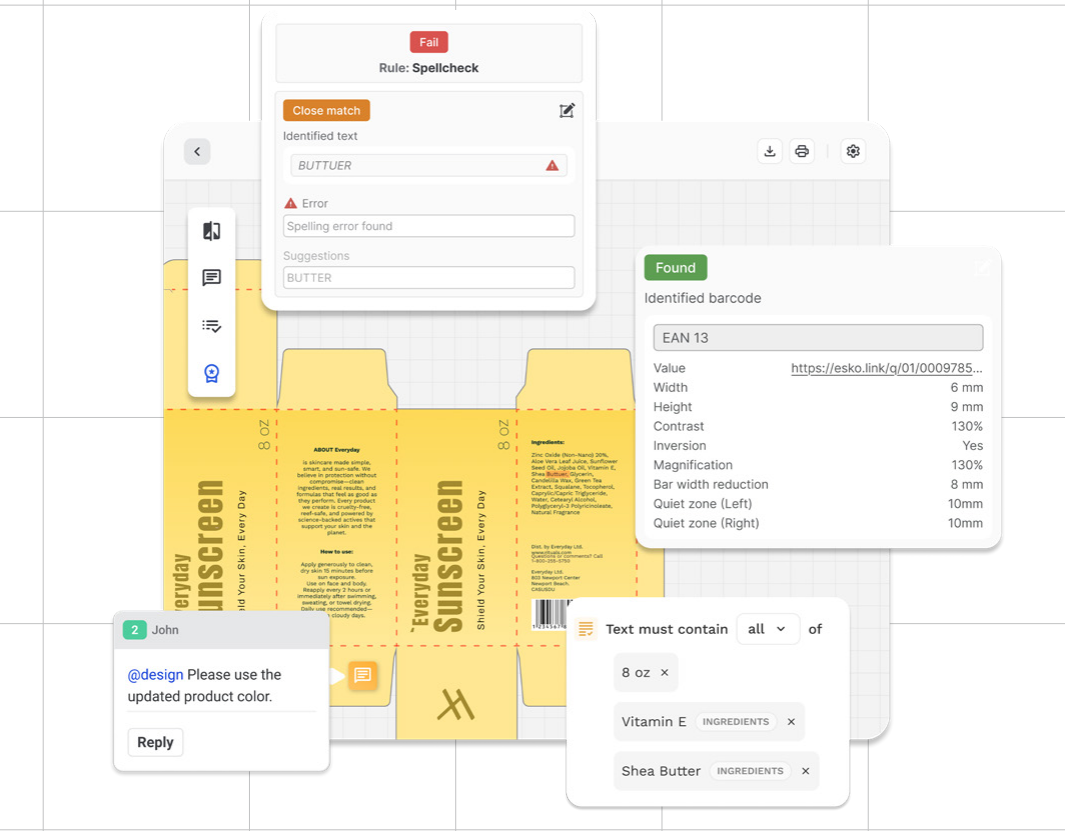
That shift changes the dynamic across the whole team too. Designers get clearer feedback earlier. Project managers stop absorbing last-minute schedule compression. And the compliance review stops feeling like a confrontation at the finish line and starts functioning as a normal, low-drama step in the workflow.
This piece covers the why — the philosophy of compliance-by-design and what's at stake when it's missing. But the practical side — how to build rulebooks, what to automate versus what to keep human, how to structure approvals so nothing slips through — deserves its own treatment.
Esko's Future of Compliance guide goes deep on exactly that. It's built for packaging and regulatory teams who want to move from reactive compliance to a proactive, scalable system — and it covers the tools, the workflows, and the mindset shifts that make the difference.
Read the full guide: The Future of Packaging Compliance →


_2.jpg)


