


.png)

Agrochemical labels are, by any measure, some of the most regulated documents in any industry.
Signal words. GHS hazard classifications. Precautionary statements. First aid instructions. Environmental warnings. Storage and disposal guidelines. Active ingredient percentages. Registration numbers. Depending on where you're selling, you may also need to comply with EPA, OSHA, GHS, or any number of country-specific regulatory frameworks — sometimes all at once.
Get one of those elements wrong, and you're looking at a failed inspection, a product recall, a fine, or worse.
That's the reality for brands like Indofil Industries, Parijat Industries, and Sumitomo Chemical — all Artwork Flow customers — who operate across multiple markets with large, complex label portfolios that need to move fast without making mistakes.
So how do you do that? How do you keep labels accurate, compliant, and moving through approval quickly when the stakes are this high?
That's what Artwork Flow is built for. Let's walk through it.
The problems that sound familiar
Across the agrochemical brands we work with, including major names in crop protection, fertilizers, and specialty chemicals, the same set of pain points come up repeatedly. They're not unique to any single company. They're structural.
1. Manual review workflows that don't scale
Routing artwork for review, gathering feedback, tracking change requests, and chasing sign-offs in many organizations still happens through a mix of email, shared drives, and spreadsheets. It works until it doesn't. The moment you're managing 50 SKUs across three markets with a launch deadline in six weeks, the cracks start to show. Manual workflows are slow by design. They're also vulnerable to human error in a way that automated systems simply aren't, and in a regulated industry, human error carries real consequences.
2. Email-based feedback that creates version confusion
When artwork review happens over email, the feedback is scattered. One reviewer sends comments on version 3. Another replies to a thread that references version 2. A third approves a version that was later superseded. No one has a clear view of what the current version is, what's been changed, what's been approved, and what's still outstanding.
Email isn't built for multi-stakeholder artwork review. The result is confusion, duplicated effort, and missed details.
3. No clear audit trail
When a regulator asks who approved a label change and when, you need to be able to answer that question immediately. When an internal review flags a compliance issue and you need to understand how the error got through, you need a traceable record of every decision made during the artwork lifecycle.
Without a proper system in place, reconstructing that trail is time-consuming at best and impossible at worst.
4. Version control that depends on naming conventions
In the agrochemical industry, label updates happen frequently. A formulation change requires a label update. A new GHS classification requires a label update. A country-specific regulatory amendment requires a label update. When version control depends on humans remembering to name files correctly — label_v3_FINAL_approved_USE-THIS-ONE.pdf — inconsistencies are inevitable.
What Artwork Flow does differently
Artwork Flow is an artwork management platform built for the complexity of regulated industry labeling. It brings together version control, automated proofing, compliance checking, annotation tools, and configurable workflows in a single platform, replacing the patchwork of email, shared drives, and manual tracking that most teams are currently working with.
Here's how that translates into practice for agrochemical brands.
1. Templatized, automated workflows
Every label type in your portfolio has its own review requirements. A crop protection product needs regulatory review, hazard information validation, and legal sign-off before it goes anywhere near a printer. A fertilizer product might need a different sequence of approvals. A product being localized for a new market needs an additional layer of country-specific compliance checks.
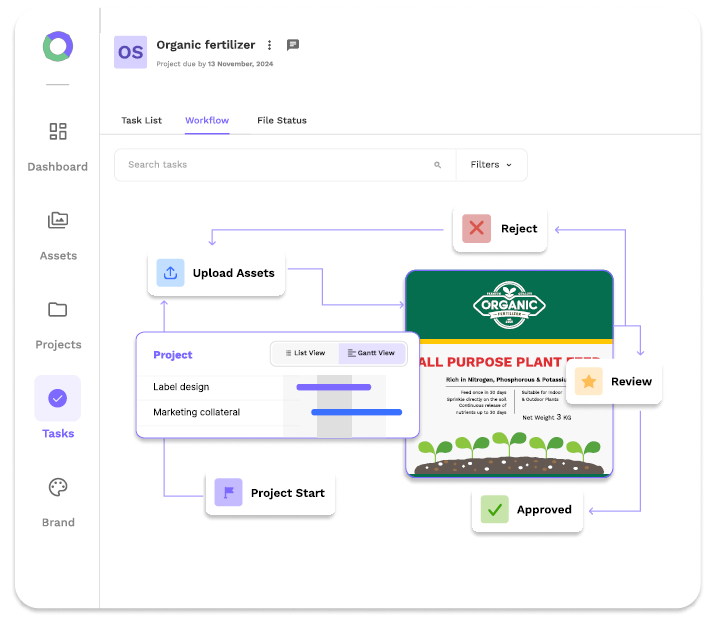
Artwork Flow lets you build and standardize these workflows as templates, then apply them automatically to new projects. The right people get notified at the right stage. Nothing moves forward until the required approvals are in place. And if a late-stage formulation change requires rework, you can retrigger specific tasks within the workflow without disrupting the rest of the process and starting from scratch.
2. Version control that's actually controlled
Every file uploaded to Artwork Flow is versioned automatically. There's one place where the current approved version lives, one place where the history of changes is recorded, and one place where you can compare versions side by side to see exactly what changed and when. The days of hunting through email threads to find the latest file are over.
For agrochemical brands managing hundreds of SKUs across multiple markets, this alone changes how the artwork team operates.
3. Automated compliance checks
This is where Artwork Flow goes beyond standard project management. The platform's automated proofing tools check artwork against multiple compliance requirements: flag missing mandatory elements, incorrect dimensions, font sizes below regulatory minimums, and absent hazard symbols. The automated compliance module takes this further, checking label content against the specific regulatory requirements for the target market.
For agrochemical labels that need to meet EPA, GHS, OSHA, or local regulatory standards depending on where the product is being sold, this kind of systematic automated checking is not a nice-to-have. It's the difference between catching a compliance issue before print or after a failed inspection.
4. Smart annotation and free proofing tools
Reviewers can annotate directly on the artwork, marking up specific elements, flagging dimensions, and noting exactly what needs to change and where. Comments are contextual and attached to specific parts of the label, not floating in an email thread. For label details where precision matters — the font size of a warning statement, the dimensions of a hazard pictogram, the placement of a registration number — this removes the ambiguity that causes revision cycles to drag on.

Artwork Flow also provides free proofing tools, meaning stakeholders outside your core team — external regulatory consultants, regional compliance reviewers, agency partners — can participate in the review process without needing a full platform licence.
5. Detailed checklists built around your SOPs
QA, regulatory, legal, design, and marketing teams each have different things they're responsible for checking. Artwork Flow lets each team work from structured checklists tied to their specific role in the approval process — ensuring that signal words, storage instructions, disposal guidelines, pictogram measurements, and registration numbers are all explicitly verified at the right stage, by the right person, every time.
No element gets assumed. No detail gets skipped because someone thought someone else was checking it.
The results speak for themselves
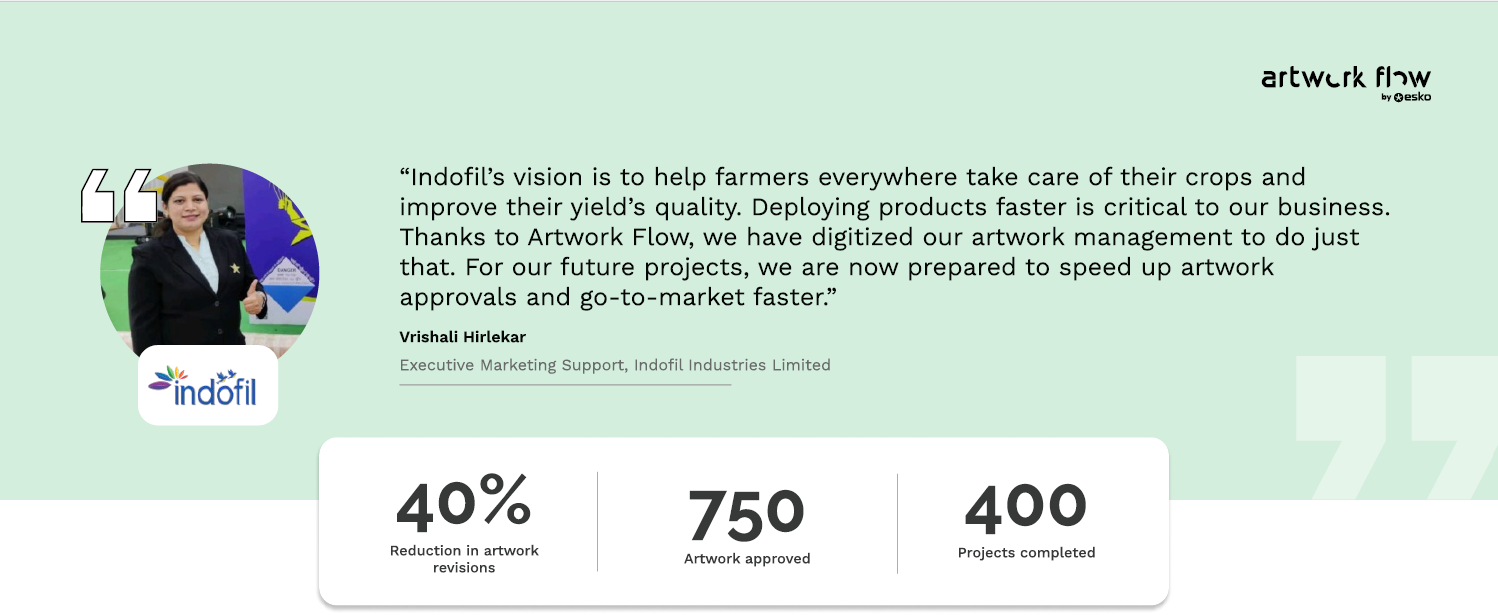
Across our agrochemical customer base — including Indofil Industries, Parijat Industries, and Sumitomo Chemical — the impact of moving to Artwork Flow follows a consistent pattern:
- 50% reduction in artwork review time
- 40% reduction in artwork revisions
- Hundreds of artworks approved and projects completed within months of going live
- Consistent on-time project completion, even against tight seasonal deadlines
Where to start
The brands that get the most from Artwork Flow aren't necessarily the ones with the most complex portfolios. They're the ones that approach implementation with a clear sense of where their current process is breaking down.
Artwork Flow gives agrochemical brands the structure, automation, and visibility to get labels right, without slowing down. If your current process is making that harder than it should be, it's worth taking a look.


_2.jpg)


